

- mandible
- Most anterodorsally situated of gnathal appendages; one, of a pair, of heavily calcified jaws; the "teeth." [Hobbs and Jass, 1988].On of the heavily calcified jaws lying anterior to (beneath, in ventral view) the other mouth parts but visible in certain crabs [Chace and Hobbs, 1969].One of 3rd pair of cephalic appendages, used to masticate food [McLaughlin, 1980].One of a pair of heavily calcified jaws situated anterodorsal to other gnathal appendages [Hobbs, Hobbs, and Daniel 1977].One of the heavy calcified jaws lying anterior to (beneath in ventral view) other mouth parts [Butler, T.H.].One of the heavy calcified jaws lying anterior to (beneath, in ventral view) to other mouth parts [Perez Farfante and Kensley, 1997].One of third pair of cephalic appendages used to masticate food [Moore and McCormick, 1969].The third cephalic appendage, and first mouthpart appendage of isopods. It generally has a lateral three-articled palp and is made up of the following functional regions: incisor process, spine row, molar process, dorsal condyle, and posterior articulation [Wilson, 1989].Third limb of cephalon, comprising a thick body with mesial molar process, terminal incisor process and mandibular palp, usually of 3 articles [Poore, 2004].(Order Cladocera):Third paired appendage of head; relatively small and simple (i.e., without palp). Typically with simple ridged or toothed distal end which extends under labrum [Stachowitsch, 1992].(Order Notostraca):Third paired appendage of head; located between small antennae and maxillules and extending under labrum. Relatively large, simple (without palp), and with toothed or spinous distal end [Stachowitsch, 1992].(Order Diplostraca):Third paired appendage of head; located between large antennae and maxillules. Simple (i.e., without palp), massive, with ridged or toothed terminal molar processes extending into preoral cavity (atrium oris) under labrum [Stachowitsch, 1992].(Order Anostraca):Third paired appendage of head; located between antennae and maxillules and extending under labrum. Relatively large, with undivided distal end. (without palp, with vestigial palp) [Stachowitsch, 1992].(Class Cephalocarida):Third paired appendage of head (cephalon); located between antennae and maxilules and extends into atrium oris under labrum. Bears terminal molar and incisor processes [Stachowitsch, 1992].(Order Cumacea):Third paired appendage of head (cephalon); located between antennae and maxillules. Represents first pair of mouthparts and, if fully developed, consists (proximally to distally) of molar process, spine row, lacinia mobilis, and incisor process. (base: pointed, truncate) [Stachowitsch, 1992].(Order Tanaidacea):Third paired appendage of head; located between antennae and maxillules. Represents first pair of mouthparts and, if fully developed, consists (proximally to distally) of molar process, spine row, lacinia mobilis, incisor process, as well as a palp. Mouthparts may be absent in male. (monocondylic, dicondylic) [Stachowitsch, 1992].(Order Decapoda):Anteriormost paired mouthpart on underside of head; borne by third cephalic segment (mandibular somite). If fully developed, bears terminal molar and incisor processes as well as palp [Stachowitsch, 1992].(Order Amphipoda):Third paired appendage of head (cephalon); located between antennae and maxillules. Represents first pair of mouthparts and, if fully developed, consists (proximally to distally) of molar process, spine row, lacinia mobilis, incisor process, and palp. (with/without palp) [Stachowitsch, 1992].(Order Isopoda):First pair of mouthparts, functioning as jaws, often sclerotized [Kensley and Schotte, 1989].(
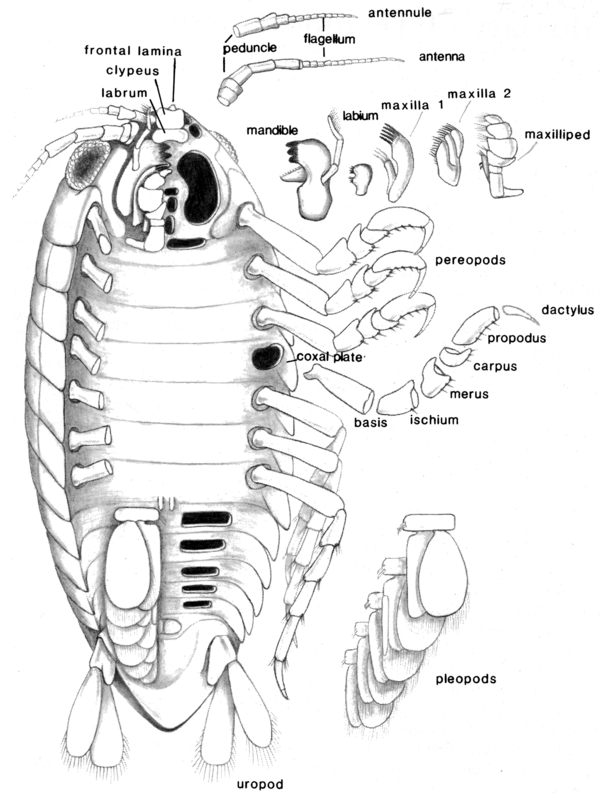 )Schematic representation of an isopod illustrating morphological terms. [Kensley and Schotte, 1989](Order Isopoda):Third pair of head appendages; first (anteriormost) pair of mouthparts functioning as jaws and typically sclerotized [Wetzer et al. 1997].(
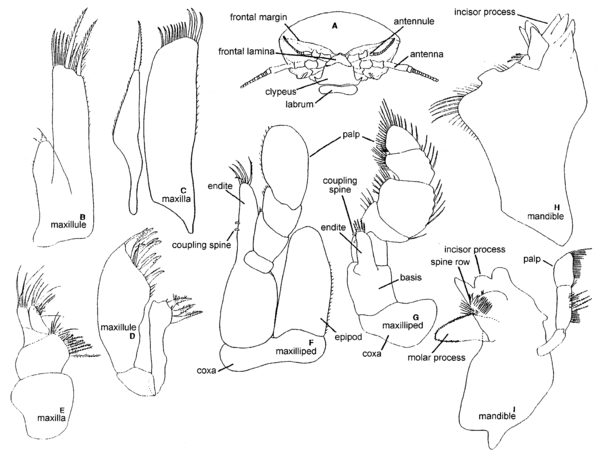 )Nomenclature of isopod cephalon (A). Examples of isopod mouth appendages: Idoteidae (B, C, F, H); Cirolanidae (D, E, G, I). [Wetzer et al. 1997](Order Isopoda):Third paired appendage of head (cephalon); located between antennae and maxillules. Represents first pair of mouthparts and, if fully developed, consists (proximally to distally) of molar process, spine row, lacinia mobilis, incisor process, and palp, (biting/chewing, piercing/sucking = styliform) [Stachowitsch, 1992].(Order Mysida):Third paired appendage of head. Located between antennules and maxillules. Represents first pair of mouthparts. If fully developed, consists (proximally to distally) of molar process, pars centralis (spine row), lacinia mobilis, incisor process, and palp. Left and right mandibles differ considerably [Stachowitsch, 1992].(Order Stomatopoda):Anteriormost paired mouthpart on underside of head (cephalon); borne on third cephalic somite. Well developed, bearing molar and incisor processes. (with/without palp) [Stachowitsch, 1992].(Order Leptostraca):Third paired appendage of head (cephalon); located between antennae and maxillules. Represents first pair of mouthparts and, if fully developed, consists of basal incisor and molar processes as well as distal palp [Stachowitsch, 1992].(Subclass Branchiura):Paired, serrate mouthpart closely associated with mouth on underside of head. Typically enclosed, along with mouth and surrounding labrum and paragnaths, in proboscis. Lacks palp [Stachowitsch, 1992].(Subclass Cirripedia):(
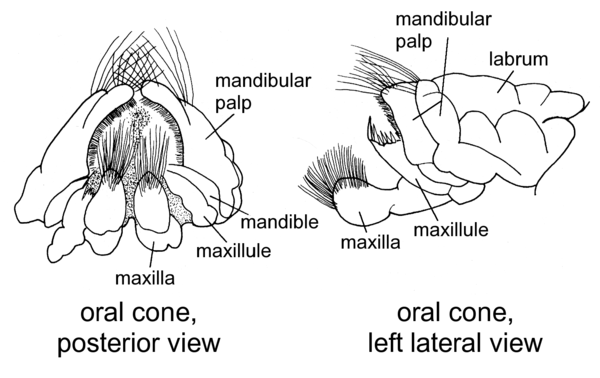 ) [Anderson, 1980].Balanus trigonus: oral cone, posterior view; and oral cone, lefft lateral view. [Anderson, 1980](Subclass Cirripedia):First pair of mouthparts on head. Consists largely of gnathobase and, in acrothoracican, bears palps. Typically closely associated with labrum. (with/without palp; serrate, suctorial) [Stachowitsch, 1992].(Subclass Copepoda):The paired limb of the somite of the cephalon posterior to antenna 2. The mandible bears a coxal gnathobase during the copepodid phase of development; it may (the fourth to sixth naupliar stages of calanoid copepods) or may not (all other copepods) bear a coxal gnathobase during naupliar phase of development [Ferrari and Dahms, in press].(Subclass Copepoda):The third cephalic appendage [Boxshall and Halsey, 2004].(Subclass Mystacocarida):Third paired appendage of cephalon; located between antennae and maxilllules. Biramous, consisting of protopod, four-segmented endopod, and sevensegmented exopod. Projection (gnathobase) of protopod extends under labrum. Serves in locomotion and feeding [Stachowitsch, 1992].(Class Ostracoda):3rd limb (3rd head limb) [Cohen, Peterson, and Maddocks, in press].(Class Ostracoda):Anterior-most paired mouthpart on underside of head. Basically a biramous, limb-like appendage consisting of proximal gnathobase and distal palp (the latter with endopod and exopod). (biramous, uniramous; falcate, stylet-like = styliform) [Stachowitsch, 1992].(Class Ostracoda):Third paired appendage of head. Mandibles flank mouth and are basically biramous, consisting of proximal gnathobase and distal palp [Stachowitsch, 1992].(Class Remipedia):Anterior-most paired, asymmetrical mouthpart on underside of head (cephalon); lacks palp. Each mandible bears three masticatory processes (incisor process, lacinia mobilis, molar process) which lie in cavity (atrium oris) between labrum and mouth [Stachowitsch, 1992].(Superorder Syncarida):Third paired appendage of head; located between antennae and maxillules. Represents first pair of mouthparts. If fully developed, consists of molar and incisor processes as well as palp. (with/without palp) (see also penicilla) [Stachowitsch, 1992].(Order Thermosbaenacea):Third paired appendage of cephalon; located between antennae and maxillules. Represents first pair of mouthparts. Consists (proximally to distally) of molar process, lifting spines, lacinia mobilis, incisor process, and palp [Stachowitsch, 1992].(Order Euphausiacea):Third paired appendage of head (cephalon); located between antennae and maxillules. Represents first pair of mouthparts and typically consists of basal molar and incisor processes as well as a distal palp. (with/without palp) [Stachowitsch, 1992].
Crustacea glossary. Natural History Museum of Los Angeles County. 2011.
